Goal of Reevaluation
By PHIL WITTMEYER & OthersAlso known as Retardation
Personality Traits

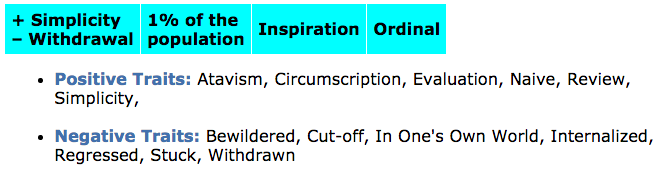
The Ordinal Inspiration Goal is Reevaluation (Reduction), and it is the "pessimistic" Goal. A good way to explain this Goal is in terms of money. The analogy of behavior in times of economic recession is very similar to the situation with people in the Reduction Goal. Just as people during a depression are thrifty and want to spend their money wisely because they have so little of it, so a person with the Goal of Reduction wants to be frugal with everything in his life. He is a "bargain hunter". He always lives as if he were in hard times and needed to get "the most value for his dollar" — but not just in monetary realms. He is continually asking the question, "Is this really worth it?". He evaluates everything to make sure it is actually necessary. He does not feel comfortable with excess of any kind. He wants to live a plain and ordinary life. In many cases, people with this Goal have a "domestic" urge, and they become "homebodies". In the home they need face fewer demands than in confronting the outside world with all its problems and complications and challenges. Here they can also avoid distractions and extremes. They certainly respect other people's privacy, so they are never nosy or prying.
People with this Goal have a value system hierarchy for everything in their experience. It is as if they have a priority list with the most important things at the top and the least significant at the bottom. They naturally assign a value of relative importance to everything. The object of this Goal is to find ways to shorten the priority list. Even if they are not overloaded, they will still be asking themselves, "Is this really necessary, or can I do without it also?" They "weed the garden" of their life. The desire is to cut out all nonessentials. They seek what is elementary, fundamental, and basic. They do not like to carry around any "excess baggage", so they "sift the wheat from the chaff" in every thing they do. Even in their speaking they do not elaborate or embellish any more than they have to.
In employment, a person with the Goal of Reevaluation is suitable for quiet and well organized situations that are not very demanding: nothing that taxes the resources of the person. If there is too much going on at once, or there are deadlines to meet, a person in this Goal will likely feel uncomfortable: he does not like intense input in his life. Nor can an employer expect a prolific output from him. The good thing about this Goal in employment is that people with it are usually single-minded in their pursuits, and can concentrate on the task at hand. They get to the heart of the matter and stay there, not dabbling in the extraneous and peripheral issues. You can count on them to take care of things in the order of their importance.
The original name of this Goal was "Retardation", but to me this seems to have too negative a connotation. The Goal has nothing to do with mental or retardation or physical handicap as one might suppose from such a name. It is true that in the worst instances it can manifest as arrested development and emotional immaturity. Many people with this Goal avoid situations and circumstances which would help them to "grow up". The reason for this is that they typically lack what others call "ambition". People with this Goal feel they do have ambition — their ambition is the desire to find what is truly essential, and eliminate all the rest as superfluous. However, this does limit the development of what others consider "maturity". People in Reduction rarely stretch themselves to the limit, and so they rarely reach their full potential. They will also often do something only if it is convenient and does not cause them any hassle — so they are often considered lazy. They dislike the "hustle and bustle" that is a part of modern civilization. Some have trouble getting up in the morning because they do not want to face the numerous challenges of another day.
Positive Pole (Atavism)
The original name of the Positive Pole of this Goal is "+Atavism". This word is not familiar to most people. According to the dictionary, it means a throwback to a more primitive state, or a reversion to traits of a remote ancestor. Indeed, people with this Goal often long for "the good old days". Life was supposedly better then, back when things didn't seem so complicated. They often prefer old homes to new homes, and antique furniture to modern furniture. They may like old automobiles better than the newer models. It frustrates them that the world seems to be getting more complicated because this is against their nature. "Recapture traditional values" is a good motto for this Pole.
Regardless of what the dictionary says, the original definition of atavism was "a return to complete simplicity". The ultimate simplicity is of course to reduce everything down to one thing at a time. People with this Goal often pare down their options so they can concentrate on one thing. They seek continually to narrow their range of involvements. They want situations such that they can cope with them easily and without stress and confusion. They avoid circumstances that are demanding or intrusive.
I like to refer to the Positive Pole as "+Efficiency", a word more familiar to most people than atavism. Efficiency is doing things with the least effort. People in this Pole are seeking to "trim the fat" from whatever they are involved in. They avoid intricacy. They hate waste, so they are very economical in their lifestyle. It also means they shy away from ostentation, ornamentation, fancy or gaudy frills, and other such "excesses". Because of their desire for simplicity and avoidance of complexity, they are often very tidy and neat in their personal lives. "A place for everything and everything in its place" is an appropriate motto for this. They are also inclined to stick with the familiar, to go over the same paths again and again to see if they can make it even more efficient.
Negative Pole (Withdrawal)
The Negative Pole is -Withdrawal. This is expressed when the person seeks to reduce his experience even below the efficiency of oneness — down to nothing. In the Positive Pole the person will extract a lot of value from the few and the meager, but in the Negative Pole he leaves everything alone, confronts nothing, and shrinks from all life experience. He prefers to "get away from it all", and he copes with problems by escaping into isolation. Interestingly enough, such people prefer dimly lit, enclosed areas. They feel uncomfortable in bright and open places. There is almost a "back to the womb" feeling here. Such people prefer to retreat to the wilderness, and they may even be reclusive, like a hermit. In any case, they are secretive, mysterious, aloof, and hard to get to know. They dislike people who invade their psychological privacy ("Mind your own business") or intrude on their physical space ("Leave me alone"): they repulse intimacy. They seek seclusion when life gets too confusing ("I can't deal with that"). They don't want to know what is going on out there in "the big, bad world", and they don't want others to know about them. At minimum, they pull the window shades, and avoid the neighbors. The way to overcome -Withdrawal is to consider and apply the Positive Pole of Growth, which is +Unfoldment (also called Comprehension): to open up to interesting things, to be all that one can be, and to become intimate with the world and with other people.
Reevaluation is the counterpart of the Reserve Mode. Both result in behavior which is less than enthusiastic or optimistic. A person with the Goal of Reevaluation would like to have his life as efficient, orderly, and limited as a person in Reserve has himself. In other words, a person in Reserve applies the principle of conservation to his own actions, feelings, and thoughts, rather than seeking this in the outer world as does the person in Reevaluation.
The Goal of Reevaluation is the complement of the Goal of Growth. That is, each avoids what the other seeks. People in Growth want to experience everything they can. They thrive on complicated and demanding situations. They almost never turn down an opportunity to develop their potential. On the other hand, people in Reevaluation often avoid experience if they feel it is too intense or confusing. They seek quiet, comforting, close and familiar situations. They start looking for a way to cut back when too many things are happening at once. Whereas people in Growth are always trying to improve things and make them better, the person in Reduction is inclined just to "leave well enough alone". After all, why mess with something he can get by with just as it is. The person in Reevaluation will do the minimum required to get by. The person in Growth will extend himself to the maximum and beyond. People in Reevaluation do not value variety for its own sake as do people in Growth. They avoid redundancy and superfluity.
 Phil Wittmeyer
Representing only 1% of the population, the goal of reevaluation is extremely rare. The polar opposite of growth, it is possible to slide to growth when the demands of a new challenge must be met.
People in reevaluation commonly suffer from a disability, which rather conveniently helps them avoid intense experiences from the outside world. They shun complications and are generally disengaged from life, shying away from "having too much on their plate" or any potential for karma.
This is often a life in review, with a rumination on questions from the past that are not always consciously clear, often resulting in the same issues being faced over and over again.
In the negative pole, people in reevaluation are withdrawn and can become reclusive and shut-in, trying to remove themselves from a life where the signal-to-noise ratio is bewildering to them.
 David Gregg
In reevaluation, our lives are quiet, or we seek that, at least. We eschew stimulation. It's about simplicity, tending to the mundane. Reevaluation pulls us inward; growth thrusts our internal experience outward.
Clients in reevaluation tell me things such as “My dream is to have a cabin in the mountains (or a cottage by the shore) where I can be alone.” However, wanting to escape from the “big, bad world” is not the same as being motivated to reevaluate. Those with a goal of growth are prone to overstimulation, and often slide to reevaluation in order to “catch up” on processing all the input they have received. People who are autistic or who are institutionalized much of their lives sometimes have this goal; it appears that nothing is happening with them, but they may actually be unconsciously processing a lot of unresolved experiences from past lives. Of course, when processing is conscious, it can be accomplished more quickly and efficiently, but not everyone is capable of conscious processing.
 Shepherd Hoodwin -- From Journey of Your Soul

Channeling About Reevaluation
When your goal is on the inspiration axis, the overall gestalt of your life is inspirational; it is a lifetime focused on your inner world. When it is contracted, it is a lifetime focused on the details, the miniature aspects of inspiration.
We originally named this goal "retardation." A ritard in music slows it down, which is the opposite of the cardinal goal, growth, which is about speeding up the movement of the inner life. The slow movement in a symphony contrasts with the other movements; it is reflective. Many people, when they hear the word retardation, think of disability, but that was not what we intended. Someone who suffers from a physical or mental disability may or may not have reevaluation as his goal. This goal is the least common of the seven; its percentage among those with disabilities is higher, but it is still not all that high.
Typically, a soul chooses reevaluation in order to digest experiences from previous lifetimes that were much more active; it is a breather. It may involve outward rest, but it is active internally. Someone with a goal of reevaluation will often state her desire to lead a simple life, perhaps to get a small cottage by the shore or in the mountains. The person may be busy, but she looks forward to retirement, to not having so much to do outwardly. It's like having a big meal in your stomach waiting to be digested.
With this goal, there may be reevaluation occurring in the sense of pulling up old experiences and looking at them in a different way. However it might simply be evaluation; in other words, she may be parsing experiences for the first time because, before that, she was so busy that she was just having experiences, without an opportunity to assign meaning to them. The inspiration axis is a lot about the meaning of life. Priest and server souls particularly seek meaning in their experiences. That's not surprising, when you consider that the inspiration axis is about the inner world--what is felt and known, making sense of experience.
As with the other overleaves, each of the goals has a positive and negative pole (aspect). None of the traits we discuss are, of themselves, negative or positive, other than the chief obstacle, which is negative because it gets in your way if you let it. However, all the other traits are positive when used constructively and negative when they become a distorting influence because the ego has been blinded by fear in some way. Your overleaves are the building blocks of your life; what you build is up to you.
The positive pole of the goal of reevaluation is "atavism" or "simplicity." Generally, the word atavistic describes a primitive culture, but what we mean here is that the nonessentials have been pared away, back to basics. One is living life simply, keeping the externals as uncomplicated as possible so that the inner process can occur. However, if all the soul wanted to do was reflect on life experiences, it could have done that without incarnating. So, in the positive pole, there is enough interface with the human world to keep it real. If you reevaluate your experiences after passing over to the astral plane, without a body, you can understand a lot of things, but you don't have a chance to apply them. You can reflect on the big spiritual issues, but reevaluating in your body allows you to more readily test your conclusions. Interacting with other humans, especially, helps keep you real. With this goal, you don't need a lot of external involvement, but you do need some; otherwise, you can drift too much into your own world.
The negative pole is called "withdrawal"--the person refuses those reality checks and avoids life. This could manifest as being a hermit, or mentally ill in the sense of being in one's own world that does not bear much resemblance to consensus reality. We are not implying that everyone with mental illness has this goal; we are simply saying that an extreme manifestation of the negative pole could be mental illness, particularly the kind that is highly cut off from others.
You may be wondering if this goal is a factor in autism; generally it is not, although it is in some cases. Autism, like any other classification, can have a variety of causes. With autism, often people are dealing with a physical body that has compromises in its neurology. In such cases, the goal may not be so much to reevaluate as to overcome a difficult challenge so that they may be able to interact more with others. To validate the goal, look for the underlying motivation: what is the soul trying to get out of this experience?
Many people with autism are using the conditions of modern life as an opportunity to bring some issues forward from past lives that can now be worked on with more help. More physical bodies survive today, because of medical advancements, but also more are compromised. One factor is various forms of pollution. Vaccines can be an issue, although they are safe for the majority of children. However, if you overload any living organism with influences that it is not well equipped to handle, it can reach a tipping point. One of the reasons this is an interesting time to be alive on earth as a human is that you are experimenting with a lot of new things, including new toxins in food and the environment; for some, it is too much.
However, when the body is compromised, it is an opportunity for the soul to bring forward unresolved issues. Today, they can be handled in a more conscientious and caring way. Therefore, while a soul is dealing with an autistic body (which can actually be a number of things; there is not just one correct definition of it), it is also able to perhaps deal with a trauma from a past life. For example, if a person was badly beaten in a past life and had a compromised neurology as a result, now there's a chance to work it out further, in a more nurturing environment. In such a case, though, the goal would more likely be acceptance or even discrimination, because the issue is more about how one fits into society. The way to validate someone with a goal of reevaluation is to perceive whether she seeks simplicity. Not everyone who withdraws is seeking simplicity.
Shepherd Hoodwin -- From Michael On Goals
In this culture, almost 90% of those who choose the goal of Retardation (Reevaluation) are mildly to severely mentally deficient. This deficiency ranges all the way from perceptual disorders to the more severe manifestations. Congenital heart difficulty is another example of the physical retardation, also children born with sensory difficulties of a severe nature and without limbs.
 Michael Teachings Transcripts
 Next page | Goal of Growth,
The Seven Goals: Re-evaluation, Growth, Discrimination, Acceptance,
Submission, Dominance, Flow
About Phil Wittmeyer
Phil is a long-time Michael student who has written several book-length manuscripts about the Michael teachings, many of them featured on this site. He has been an active member in the community for many years and can be found at most Michael gatherings.
Phil currently lives in Colorado.
Did You Enjoy This Article? Share It With Your Friends

Shop at the
New Age Store
Comments
RELATED ARTICLES

The Seven Goals
By DAVID GREGGOur goal sets the theme for a lifetime, acting as a primary motivator that guides our course of direction in life.
READ MORE
The Overleaves
By Various Authors - AUG 16, 2015Learn about the Overleaves, personality traits that shape our individual experence during each lifetime.
READ MORE