The Seven Centers
by DAVID GREGGA COMPREHENSIVE GUIDE
Home> Overleaves

Introduction to the Centers
Introducing the Moving, Emotional, Intellectual, Instinctive, Physical, Higher Emotional and Higher Intellectual
“All Fragments have all Centers operative within themselves, but there is a strong tendency for the personality to become fixed in one Center. The Center has a great deal to do with responses. It indicates from what part of yourself you will act.”—Messages From Michael, p. 113.
Serving as primary energizers, centers govern how we experience life, and how our response to experience is expressed. In the Michael teachings every person has one center that predominates in their life, and this is commonly referred to as the center of gravity, since when we respond to something we are then using this primary centering. Each center could then be thought of as a window that looks out at the world.
There are seven centers in all, and four that are used routinely: Intellectual (thought), Emotional (feeling), Moving (action), and Physical (sensation), as well as two rarely accessed centers: Higher Emotional, and Higher Intellectual (portals to Essence). The Instinctive Center runs continuously in the background, the central operating system in the body, and rarely acts as a primary center.
More importantly, no center is better than another.
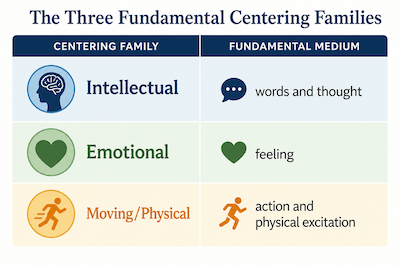
The higher centers are considered transformational states of awareness, and they are not dominant in our experiences, encountered mostly during meditative states, or peak states activated from exposure to music, art, and sex. Since prolonged exposure to the higher centers eventually burns out the body, no one is ever centered for more than brief periods there. The instinctive center can also be used as a primary center, but this is extremely rare since it operates in the background of our lives already, so life continues in the foreground.
Centers usually represent the most prominent part of a person, especially how the person is perceived by other people. They are a vital component in the Michael teachings, but are often misunderstood or overlooked by most students. However, mastering how to react from the center that's most appropriate is an important part of spiritual growth.
Understanding centers involves learning to understand how people can react so differently to the stimuli around them. For example, intellectually centered people might view their perceptions of the world as reality itself, and this can make it very difficult for them to comprehend how an emotionally centered person can view the world so differently.
Since these psychological investments in reality can be so dominant in life, adopting the different perspectives of other centers can sometimes feel to some like we're attempting to change the established laws of gravity. Not surprisingly, many of the misunderstandings that occur between people are directly related to differences in centering.
At the same time, sometimes those with different centering can help balance one another. Everyone could benefit from having more clarity and understanding in their lives, a gift of the intellectual center. The gift of meaning and connection comes from the emotional center; action and effectiveness from the moving center; stability and bodily awareness from the physical center. When these gifts from the centers are acknowledged and respected, balance is the result.

Different Perspectives

One way to illustrate how the various centers view the world is to create a real world scenario. Imagine four friends, each with a different center, sitting together at a baseball game. The Physical centered friend watches the game and sits quietly. A rush of excitement churns through his body each time a player gets a hit or scores a run. Later in the game, an attractive woman in a short skirt slowly walks by in the aisle below him, and he suddenly feels sexually aroused. However his thrill is short lived because the persistent roar of the crowd gives him a headache, and strangely he also begins to feel nauseous.
The Moving centered friend has a different focus. Being spatially oriented, he scans the field and admires the geometric shape of the grassy diamond, noting the distance between the bases and the foul line. He is aware of the signs the third base coach secretly flashes at the base runners, and will probably have them decoded by the end of the third inning. He can also tell before his friends can that the crack of the bat and a visually identifiable arc of the ball determines if it will clear the outfield fence for a home run.
The Emotional centered friend notices the people around him in the stadium, and eavesdrops on their conversations. He discerns that the elderly couple in front of him seem upset about something, even though he can't quite hear what they're saying. He also feels sorry for the usher who's being accosted by a couple of drunken teenagers in the aisle behind him. He does all of this while simultaneously trying to watch the action in the game, which he feels seems slow moving tonight, and really kind of boring.
The Intellectually centered friend is busy discussing the on-base percentage of the batter coming up to the plate, and is berating the logic of the manager for not using a pinch hitter. The Moving center friend stomps his foot in disagreement, while the Emotional centered friend makes eye contact and seems to listen attentively, but is still trying to follow the conversation of the elderly couple in front of him. The Physical centered friend gives a placating nod, but secretly hates that the Intellectual centered friend always criticizes the team. The Physical centered friend suddenly begins to feel nauseous again.
As was demonstrated, the centers present very different windows to the world, but even though we predominantly focus on one, all of the centers are available to us and a chief part of balancing our energy is directly related to how we learn to juggle them collectively and efficiently.

Parts of Centers
The primary centers each have three parts: emotional, intellectual, and body (moving/physical). During childhood development, a primary center and a preferred part in which to slide are established. To give an analogy,, think of the primary center as home plate, and the other parts as the bases on a baseball diamond. The primary center is always home, where we step up to the plate, swing for the fences, or strike out.
The primary center governs reactions, and the preferred part is how that reaction is expressed.
In the course of a lifetime, the primary center is used the most, and sliding to the preferred part becomes a secondary response, as well as a potential trap. Therefore the third part tends to be the least developed. The third part, however, is also the lever that helps balance the primary and secondary centers.
For example, people in the Moving part of the Intellectual center who have a healthy balance in their centering might think about something, act on the thought, and eventually feel something about it. It's a three-step process.
However, a pattern of sliding to the Moving center and staying there can become so entrenched that it's difficult to access the emotional side of the centering. An imbalance is created, and this process of thinking thoughts and taking action without knowing how to feel about them can follow an endless loop. In other words, the third response goes back to the center rather than on to the least-used area of centering. The trap begins when an incorrect, knee-jerk response replaces an appropriate one in a situation.
It is also important to note that every response to a stimulus does not need to involve all three centers, only the appropriate ones. Descending a flight of stairs while trying to manage each step from the intellectual center, for example, is a good way to topple unceremoniously to the bottom. Conversely, attempting to ace a calculus exam while focused in the emotional center may ensure a grade of F, decisively written with a red-felt pen from your exasperated instructor.
Right response begins with the right center.
CENTERS — BALANCED USE vs TRAP LOOP

Balancing the Centers
In order to achieve balance and avoid getting stuck in the trap of one particular center, the standard procedure is to distract part of the centering. This quote from Chelsea Quinn Yarbro's book, "More Messages From Michael," gives the following advice:
...a fragment is in the moving part of the intellectual center and wishes to have a better understanding of its emotions. Taking a long walk--nothing too rigorous or involving--distracts the Moving center so that the intellect can reach the emotional center. If the fragment is in the emotional part of the intellectual center and is having trouble getting going on a project, then listening to pleasant music might distract the emotional center so that the moving center could get into focus.
It is important to understand that balancing the centers does not mean the primary center is no longer dominant. There is just greater flexibility available, and the ability to choose the most appropriate part of centering for any given situation. Shepherd Hoodwin offers the following:
With a balanced, intellectually centered person, responses are still first through the intellectual center, although they may quickly go to another center through its part of the intellectual center. So if action is what is most appropriate, he will get that through a quick analysis and almost instantly go into the moving center through the moving part of the intellectual center. For someone in the emotional part, the emotional center will usually come second, but it can be another part if that's more appropriate. Our primary center is like the "traffic controller" that directs our responses to the appropriate place. An emotionally centered person will feel what is most appropriate. A body-centered person will sense it on a gut level.

The Emotional Center and the Axes
While all people use the emotional center to varying degrees, the axis of the role may influence how emotions are metabolized. The emotions felt are the same garden-variety emotions everyone experiences, regardless of axis; what differs is how the role axis may color their interpretation and expression. what differs is how the axis shapes their expression. Depending on the role, emotional expression tends to follow the patterns of the inspiration, expression, action, or assimilation axes. Understanding these patterns helps reveal why two people may feel the same emotion yet express it in profoundly different ways.
For example, anger as a universal emotion is still anger. But if expressed through the inspiration axis, as seen in the server or priest, anger can cargo the extra baggage of moral outrage or righteous indignation. Through the expression axis, from an artisan perspective, the anger may take the shape of an expressive form—an image, a mood, or an imaginative distortion—while through the sage lens, the anger may seek a dramatic outlet via voice, sometimes adopting a stagy persona, and drifting into prolonged oration. Through the action axis, the warrior may express anger through confrontation, a show of force that's protective and coercive—while the king may assert their authority, either restoring order or succumbing to imperious outrage. Finally, through the assimilation axis, the scholar may internalize the anger, over analyzing the emotion in a form of intellectual dissection that leads to imbalance.
● INSPIRATION AXIS: The inspiration axis energy infuses the Server and Priest roles. They are best integrated through a lens that's transformative, inspiring, and altruistic—finding meaning in feelings that are empathetic and visionary. Emotions that integrate through the negative pole digest poorly, leading to fear-based sojourns into states of self-imprisonment or fanaticism.
Assessed as a whole, does the energy behind the emotion support the higher good, or does it linger in shadows that are suffocating or self-righteous? Servers often use emotions as an impetus to help others; priests respond to their emotions as vehicles to uplift their flock.
Understanding emotions through the inspiration axis involves discerning whether an emotion is authentic or a cling-on from someone else. In such circumstances, the proper balance is to feel the pain of others but not absorb it. Detach when necessary.
● EXPRESSION AXIS: The expression axis energy infuses the Artisan and Sage roles. They are best integrated through the elements of creation and expression. Composers convey emotion through sound; writers, through words; painters, through color; actors, through subtext. They translate feelings into form, and their form becomes art.
Emotions without authentic expression leave the expression axis an empty canvas or words without meaning, resulting in artificial constructs and oratorical glibness. In short, the Artisan may produce artifice and the Sage may fall into glib oration.
The expression axis needs to emote—to breathe life into the canvas with genuine originality and a cup that runneth over with sagacity.
● ACTION AXIS: The action axis energy infuses the Warrior and King roles. They are best integrated through directed will: doing and delegating. Feelings are acted on, put into motion, and commanded to fall in line. They have a purpose, and their purpose is in service of a goal.
For warriors, emotions are driven by duty, loyalty and knowing who they are defending. In kings, cardinality lends an authoritative scope, bestowing mastery, coordination, and effective governance. Emotions can be raw, as in the warrior, or commanding, as in the king, yet in both cases they motivate action.
When negatively expressed, however, a perfect storm gathers that's fierce, unyielding, and sometimes cruel. Instead of imposing will, demonstrate expertise and magnanimity. Instead of ruthless enforcement, let go of control and focus on the positive outcome of the goal.
● ASSIMILATION AXIS: The assimilation axis energy infuses the Scholar. The role is best integrated through converting raw emotional data into a source of study and knowledge. Like the way they synthesize knowledge, they do the same with emotions.
Unlike other roles, they characteristically ask why and how their emotions manifest, and they use this knowledge to fill gaps in their psyche.
When they over-analyze their emotions, however, they easily get lost in abstractions, and can cloak their feelings behind the theoretical, blocking their ability to express emotions authentically. The solution is to allow the emotion to resonate fully, but with just enough scholarly detachment to avoid being consumed by the process. Avoid the trap of substituting analysis for feeling.
In summary:
● Inspiration asks what the emotion pushes you to serve or change.
● Expression asks how the emotion wants to be communicated.
● Action asks what the emotion urges you to do, protect, guide, or control.
● Assimilation asks what the emotion helps you notice, understand, and absorb.

MICHAEL: The filtering of emotions through an individual axis helps organize emotional expression in a way that aligns with the role and makes emotional expression productive rather than a scattered array of chaotic outbursts. Working with this knowledge "consciously" helps provide a compass that steers the life through choices that reflect the directives of essence rather than the distorted, and haphazard mishaps of false personality. Although all paths lead to growth, a little fine-tuning never hurts. In this way, the process brings order to the emotional center.
Understanding how emotions run through the filter of a particular axis can be a powerful aide when balancing the centers. People have grown accustomed to falling into patterns they learned from other sources, such as parental conditioning, programs on TV and movies, and inspirational figures (actors, athletes, musicians, school teachers, friends) that they have used as models of behavior. Emotional patterns in this vein are disingenuous expressions, like random fragments of a film script that bear no resemblance to the true personality. The emotions generated are real, but their expression is artificial. This creates a block in the flow of energy from the other centers.
A careful study of how the axes of an emotion influence the roles is another tool that can help achieve greater authenticity in navigating life with fewer pitfalls and more balanced reactions to what occurs day by day.
To better understand the individual perceptions and attributes of the primary centers and their various parts, a brief description is provided for each one.
The Seven Centers
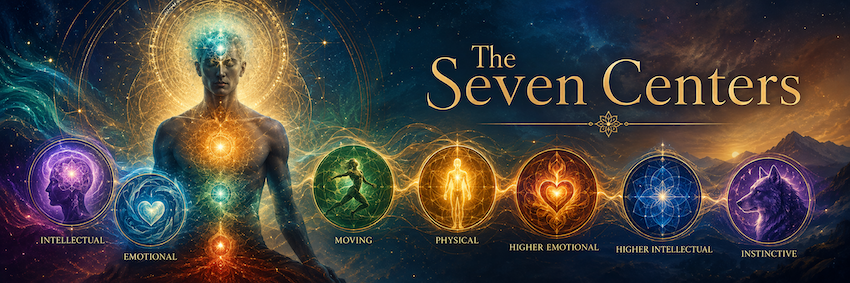
The Moving and Sexual Centers are kinetic, the Emotional Centers are mute, having to do with feelings rather than words. The Intellectual Centers are the verbal Centers.—Messages From Michael, p. 114
The Moving Center
People in this center experience life through physical movement and action. They tend to be human dervishes of activity, preferring the feel of being in motion. They are always on the go, and can be indefatigable workers.
This center has a high tolerance for repetitive tasks, or routine in general. Occupations such as assembly, data entry, food service, or agriculture, which involves performing the same tasks repeatedly, are rarely a problem and often enjoyed. In fact, this is the one center that can comfortably accommodate the sometimes boring aspects of routine. Though, persons in the intellectual part of this center are a possible exception.
Because of the natural enthusiasm for physicality, athletes prefer this centering, as well as dancers, inventors, and even surgeons. Any skill that requires hands-on application is usually excelled at.
People with this centering are also very in touch with their bodies, and kinesthetically can determine if there is something wrong.
In the positive pole of Enduring, bodily movement has a purpose and a natural conclusion. In the negative of pole of Energetic, there is a restless, fidgety energy that flows with no discernible purpose.
In the Emotional part: This part is easily observed. There seems to be an interest in moving for the sheer joy of it. Being in motion feels good to these people, and you can see it in how they walk, and in their normally dramatic gestures. Movement is how they express their emotions. It gives them a rush or natural high, and can be accomplished in activities such as dance, skateboarding, white water rafting, sex, and so forth.
During times of stress, it's not surprising to see people with this part release emotion by doing a domestic chore, such as vacuuming the rug, or washing the dishes. When expressed through the negative pole, people in this center can become obsessive, and waste valuable energy compulsively shopping, gambling, or thrill seeking in the face of obvious dangers. Nervous twitches also seems to be a negative manifestation of this part.
In the Intellectual Part: Movement requiring thought is the focus here. Inventors are especially suited for this part, as well as architects, surgeons, engineers, and actors. People in this part tend to be good with mathematical calculations, or anything that requires sustained attention as long as it isn't mindlessly repetitive. These people are project oriented, and gifted in the area of spatial intelligence.
In the negative pole, people in this part can get trapped in purposeless movement, such as devoting hours to video games.
Read more about the Moving Center
The Emotional Center
People in this center experience life through their feelings and their connections with others. It is a favorite center for Mature souls as it allows for greater intensity in relationships. With feelings so prominent, the emotionally centered are the most likely to take things personally. Every experience becomes relational: What does this say about me? Am I loved, respected, or rejected? In the emotional center, feelings arrive faster than facts.
Throughout the day, the emotionally centered cycle through fervent feelings: joy and sadness, fear and anger, surprise and disgust—assembling them like ingredients for a cake, an emotional recipe mixed with the ease and familiarity of an accomplished baker. Those with other centers view this as excessive moodiness, or borderline instability, but from the perspective of someone with this center, it's simply the way they bake.
Since emotional responses move faster than thought, this center operates more rapidly than the other centers. The center reacts in a fast binary: yes/no, like/dislike, safe/unsafe. No syntax, no story, no deep ponderings—just an immediate response. For some people, this impairs verbal fluency—feelings arrive faster than language does. Impressions first, words second. Many emotionally centered individuals, however, eventually overcome this impediment and become successful writers, actors, and teachers.
With this center, there's an innate talent for getting to the core of an issue and assessing a situation rapidly. The emotionally centered excel at reading a room. At a startling velocity, they can detect minute details in the people around them and their surroundings. Not through strange perturbations in the sensory field or pseudo-quantum claims, but through a sensitivity to micro changes in facial expressions, the concealment of something in the tone of voice, or a sudden shift in the atmosphere of the room. Impressions flash through: Her strained smile says she's angry. This situation isn't safe. This person is lying to me. These can be surprisingly accurate. Not because of psychic endowments, but from reading subtle cues and distinct patterns freighted in a single impression that races at near-lightning speed. At least compared to the intellectually centered, who, during this time, are still processing their first thought.
Emotionally centered people are highly sensitive, quick to offer physical affection or sympathy, and prized as friends and confidants due to their warmth. They also tend to attract friends who operate from centers not using emotional centering, such as the intellectual or moving centers, since this fills a void for these people. However, intellectual or moving-centered people are often baffled by the negative outbursts that erupt from the emotional center. Indeed, this center can be like a walking powder keg, and it's naive to think that the energy will always be warm and positive.
Although they may boast cheery dispositions by default, they have strong likes and dislikes that grate on the nerves of others. They overreact and blow things out of proportion—the distraught man at the upscale grill whose filet mignon arrives still bleeding, not well-done; the aspiring singer at karaoke night who flees the event sobbing when her medley of songs from Wicked clears the room. This extends to relationships—these people either love you or hate you, with rarely an in-between. Emotions seldom appear as a trickle, but arrive full-stop, instantaneously—a bulging dam at the point of collapse. In these negative pole expressions, this pattern is best described as a chain reaction of stimulus → feeling → body reaction → story.
A low tolerance for boredom is common, and arguments develop for nothing more than the quick fix of emotional intensity. The usual culprit: the status quo suddenly lacks emotional texture. A scarcity of felt experience. The present circumstances have flat-lined into emotional numbness. Nothing is colorful, nothing is festive—just a circuitous torture of drab routine, like being stuck in a line at the DMV that wraps around the building. Intolerable for the emotionally centered, who live for those all-or-nothing bouts of stimulation. A strategically engineered squabble with whoever is around can ease the monotony.
The inspirational qualities of the emotional center provide a haven for those with artistic temperaments: actors, singers, musicians, poets, writers, filmmakers, and designers of all kinds—fashion, graphic, interior, architectural. Painters and sculptors in the fine arts thrive in this center, along with those in caregiving professions: crisis hotline workers, daycare workers, hospice workers, social workers—any means of employment that nourishes a need for genuine feeling and connection.
This is the center most likely to act on charitable impulses when passing someone asking for money on a street corner. The emotionally centered naturally feel the plight of others on a personal level. They share the discomfort and seek to ease it, guided by calls for unity, such as "We're all in this together." On the inspiration axis, this center exerts a gravitational pull that prioritizes caring, and the shared humanity that celebrates all souls as one. Save a heart from breaking, and you spare the world one more broken heart.
Positive Pole of Sensibility
In the positive pole of Sensibility, perception is keen and rapid. Emotions surface as little emissaries of feeling-states, appearing randomly, sometimes minute by minute. Accustomed to these states, those in this center wear their feelings with the ease of trying on clothing, with unused emotions left on hangers, waiting to be worn another day. From this perspective, people accept their emotional reactions as homegrown, without blaming others for their negative feelings.
The positive pole (with its connection to Essence) acts as a natural filtration process, purifying negative emotions before they create pain and distortion. To reach this healing state, the same advice is applicable to all of the poles: fully embrace the emotion with self-awareness.
When away from the ill effects of the negative pole, the emotional center allows genuine states of empathy and compassion for others and the self. One could compare the emotional fluency developed in this center to a naturalist strolling through familiar woods. Over time, they've explored all paths to take, intimately know the wildlife, recognize every tree—the deciduous, the evergreens—and see the signs others miss: a discarded nut from a squirrel, or telltale tracks left in a bank of fresh snow. The emotionally centered possess the same literacy with emotions. Like naturalists of the human heart, they truly see, hear, and feel the well-worn path of their emotional environment, and sense these states in others.
Negative Pole of Sentimentality
In the negative pole of Sentimentality, perception is distorted and subjectivity runs rampant, leaving one at the mercy of excessive feelings that blur the truth. At its most theatrical, jags of convulsive sobbing, quaking shoulders, and digging for tissues follow the hypersensitive like a shadow.
The emotionally-centered invariably over-identify with their emotions. In this delusional state, feelings are mistaken for fact, and fact becomes fantasy—the emotional center equates feeling with reality.
"Because I feel ignored, you are rudely ignoring me!"
"Because I feel triggered, you meant to push my buttons!"
Like a funhouse mirror, the image of their feelings reflects back to them in deceptive ways. If positive, the feeling provides a compass that guides to the truth. If obscured by fear, the mirror distorts the truth into a mere caricature of reality. These darker elements can have grave consequences.
In Shakespeare's Othello, Iago convinces Othello of the false charge that his wife, Desdemona, has committed adultery. "Because I feel betrayed, Desdemona must have betrayed me!" In a tragic example of this pole, Othello later strangles his loyal wife—mistakenly basing his action on feelings of betrayal, not factual evidence.
With Sentimentality, unchecked self-absorption becomes debilitating. Unhealed grievances from the past cast a shadow on new opportunities and experiences. Feelings cloud judgment and the ability to see the world without a jaundiced eye. Worse, a soul lost in this state enjoys the drama, savoring its worst elements—milking self-pity as if pain were nourishment; clinging to past wrongs as if resentment were a shield; using shame as permission to remain broken.
In the Moving Part: People in this part act on their emotions. They have a feeling, and then send it into action. Artisans are often fond of this part as it allows their creativity to spring forth directly from their emotions.
Generally gregarious, people influenced by this part can be warm and caring, and are absolute push-overs for anything cute, such as puppies or children. They are good with social obligations, such as birthday cards, or holiday greetings, and are quick to offer hugs or affection. Sentimental movies, stuffed animals, love songs, and soap operas reflect the sometimes conventional tastes of this part.
In the negative pole, a fondness for gossip can be cultivated, and people with this part can be petty, jealous, and vindictive. Compulsive behavior like eating disorders and drug abuse can originate from this part. There also is a tendency for temper tantrums, domestic strife, and in worse case scenarios, irrationally following judgements that can result in crimes similar to those perpetuated by mob mentality.
In the Intellectual Part: People in this part intellectualize their perceptions and feelings. They can process perceptions faster than any of the other centers, and possess the ability to peel away the layers of a problem to reveal penetrating truths. The perceptions can be startlingly accurate, and even transcend the most ardent demands of intellectual analysis.
Aesthetic discrimination is a hallmark of this centering, and there is an inner knowing of greater creative artistry, no matter how conventional the surrounding environment might be. The artistic mastery of Shakespeare and Van Gogh serves as a fine example of the astonishing heights this centering can reach.
In the negative pole, people in this centering can become deluded by their emotions and invent reasons why they are having them that rarely reflect reality. Endless rationalization can also manifest, which leads to a non-stop loop of intellectualizing with little reward. Obsessively reviewing old problems can result from this, as well as petty jealousies, prejudices, and grudges.
This particular flavor of emotional centering is not always the easiest to recognize, as the intellectual part can make it seem cool, and not as effusive as traditional emotional centering.
Read more about the Emotional Center
The Intellectual Center
People in this center experience life through the power of thought and analysis. This is the type of intelligence normally considered intelligence, and it is the seed of communication as we know it. Commonly referred to as left-brained thinking, this center is primarily linear in function.
Philosophers, scholars, theorists, and bookworms are likely candidates for this centering, as well as people in professions where a logical and discriminating mind is required to process ideas, numbers, and abstract concepts.
Surprisingly, unlike the quick response of the Emotional center, Intellectually centered people actually react very slowly. In fact, you can almost imagine the gears turning as a problem is considered and analyzed. The center insists on seeing all the parts in the whole, and understanding how a given subject relates to everything else. Frustration soon sets in if a series of ideas are not logically connected in one way or another.
Reading, writing, and good speaking skills are a function of this center, as well a rich vocabulary. Games such as scrabble, chess, backgammon, and text adventure games are favorite ways to pass the time. Essentially people with this center love to use their minds, and will get bored if there isn't some sort of mental activity to keep them stimulated.
A common downside to this center is a lack of warmness in personal relationships. People with this center can become so cerebral that they find it difficult to make emotional connections with others. Feelings can seem irrational to them, and attempts to communicate with those who possess emotional centering can be a baffling process.
In the positive pole of Thought, spontaneous thinking, or the "Aha" experience are common. In the negative pole of Reason, too much time is spent attempting to intellectualize without the use of accurate data.
In the Moving Part: People in this part take action on their thoughts. Emotions tend to be set aside, and for this reason many Old souls favor this centering since it allows them to take a break from the drama of the Mature soul level.
Individuals with this centering can seem like walking fact machines. Information is collected, and subsequently retrieved by association, spurring a data dump of whatever facts, opinions, or moral precepts have been stored there. Scientists naturally tend to love this centering, enjoying the ability to work with complex formulas without the interference of emotion. This is not to imply that people with this centering are without emotion, but there usually is a conscious effort to set emotions aside.
Action is always directed outward in this centering. A thought is formed, and usually an external action will result. For example, thoughts of anger might result in reactions such as slamming a fist down on a desk, or kicking the waste paper basket. People in this centering can also develop odd physical quirks, such as nervous twitches or a tendency to tap their fingers endlessly.
In the negative pole, people in this centering might take action without properly assessing the emotional impact. They may blurt out the first thing that pops into their heads, not realizing that their words may carry emotional ramifications. Learning how to appropriately channel energy (anger, depression) is a frequent lesson for people with this centering. Falling into a futile rut of endless deliberation is also a manifestation of this centering.
In the Emotional Part: People in this part think then feel. They get emotional about ideas, theories, events, and so forth. A gamut of emotions can result from a single thought, ranging from sheer joy and exhilaration, to anxiety and embarrassment.
People with this centering tend to have many friends, as they are good natured and communicate well others. They also make good teachers, winning many students over with an effusive personality that makes new ideas exciting.
In the negative pole, an endless loop can be created as thoughts and feelings are frenetically deliberated, with no perceived way of taking action.
Read more about the Intellectual Center
The Physical Center (Sexual)
People in this center are active and finely tuned to physical sensation. Out of all the centers, the physical is most likely to have the strongest visceral reactions.
This is the ordinal center of the action axis.
With this centering, due to its ordinality, most repercussions to events are accompanied by an inward thrust of energy, like a chain reaction of little implosions. Physical sensations associated with emotion, anxiety, and other hormonal and chemical responses are unusually heightened in their effect.
The typical amalgam of physical manifestations are some of the following: feelings of peace and joy may radiate through the body with intense pleasure; sexual arousal and release may be profound or even sublime; clenched-fist bouts of anger, sickly waves of anxiety or emotional upset often sit menacingly in the pit of the stomach, causing nausea or a need to vomit. Guttural reactions are common to this centering.
This awareness of the body and its inner mechanisms differentiates this center from the others. The body, with its intricate network of systems, both autonomic and somatic, becomes a touchstone for deciphering the mixed signals in the world and uses these physical impressions to help make sense of it all, incorporating a variant of gut logic to any interpretation.
Overall, this ordinal action center then serves as a barometer of physical sensations. The body tingles, throbs, buzzes, shimmers, trembles, flutters, along with a docket of other internalized kinetic reactions.
The focus of the physical center is often vibrational, the energy of a wind chime or a plucked string, for example. In that sense, the pulse of the center resonates like a musical instrument — a violin, per se, and life is the bow. But on a more practical level, the center acts as a tuning fork in the body, an internal compass that, through close monitoring, can help assess the mental and spiritual health of a person, and whether a course correction is needed. For instance, is the energy expansive, aglow, flowing, and warm, or is it heavy, untethered, knotted and explosive? A daily tally of these sensations offers important clues.
Originally called the sexual center in the Yarbro books, the term was later changed to the more neutral, physical. The excitations of sex are certainly governed by this center, with the elevated heart rate, increased blood flow, and the reward of pleasurable sensations, but to illuminate only the carnal aspect of the physical center is limiting.
Some channels have argued that the physical center is cardinal (or exalted) in energy, even going as far as to call it the higher moving center. But when you examine how the center manifests in a personality, all the earmarks of ordinality are evident. Whereas the moving center is outward and expansive, with an impetus to take action, the physical center is internalized and withdrawn, focused more on inner sensations and looking inward; the action occurs within. Even sex, although the act often facilitates a slide to the moving center, is one-on-one.
Compared to the cardinal action center, the ordinality of the physical center is narrowly focused and contracted. Rather than the muscle and brawn of physically directed enterprise seen in the moving center, where dancers and athletes seek peak performances, the activity of the physical center is more corporeal, with agitated states that vibrate down to the molecular level, and further, to the electromagnetic spin of subatomic particles.
These physical excitations, which include sexual highs, states of anxiety and what adrenaline junkies call a rush, are the key to understanding the physical center. The manifestations exist within the body; internalized movement that does not stir the air or burn calories. The energy is contained and, by its nature, more importantly, ordinal.
In the positive pole of BEAUTY (sometimes called Amoral), people in the physical center are animated by the simple fact of their existence. There is beauty in being in a body. There is beauty in having experiences. Living life feels like enough.
In the negative Pole of DESIRE (sometimes called Erotic), a yearning for heightened sensations may lead to unhealthy avenues of stimulation, such as addictive disorders, quick-fix gratifications, and erotic fantasies. Sexual objectification may create ego formations that fragment the personality and take on a life of their own.
Channeling from Michael:
When speaking of the physical center, it is important to contrast the differences with the moving center. Both centers involve the body, but the moving center is like an extension of the body, with a drive to be outwardly physical and engaged to face the challenges in the world. Inversely, the physical center involves fully inhabiting the body and being immersed in the sensations of the physical form. We view the moving center as a vehicle to meet the physical demands of life, while the physical center is more about being at one with life.
The physical center has an inner-directed quality, lending a greater awareness to the more passive side of being physical, as if the body is a computer-driven mechanism and the operator is merely reading the code that allows the internal programs to function. This instills a sort of hypersensitivity to the inner workings of the body, and an intuitive knowledge of the instinctive center running in the background. Thus, people with physical centering are often the first to know when the body is not functioning at optimal levels. They immediately sense the imbalance.
As expected, aside from varied influences from overleaves, bodily sensations are more pronounced with this centering, which sometimes results in a psychological array of yearnings that may border on obsessions.
Instinctive-driven negative emotions, in particular, because of the magnitude of unsavory sensations generated, can be overwhelming. But they are also easier to remedy given the body-memory of those with this centering. In other words, the root cause of the sensations are easier to track.

Self-Test: Discover Your Primary and Secondary Centers
In the Michael teachings, every person has a center of gravity—the center that most strongly colors how you experience life. Out of the seven centers, there are four that can serve as primary or secondary centering: Intellectual, Emotional, Moving, and Physical (Sexual).
Instructions: For each statement, rate how true it feels for you on a scale of 1–5:
- 1 = Not at all true
- 3 = Somewhat true
- 5 = Very true
Choose the number that fits you best for each item, then click Show My Results.
The Instinctive Center
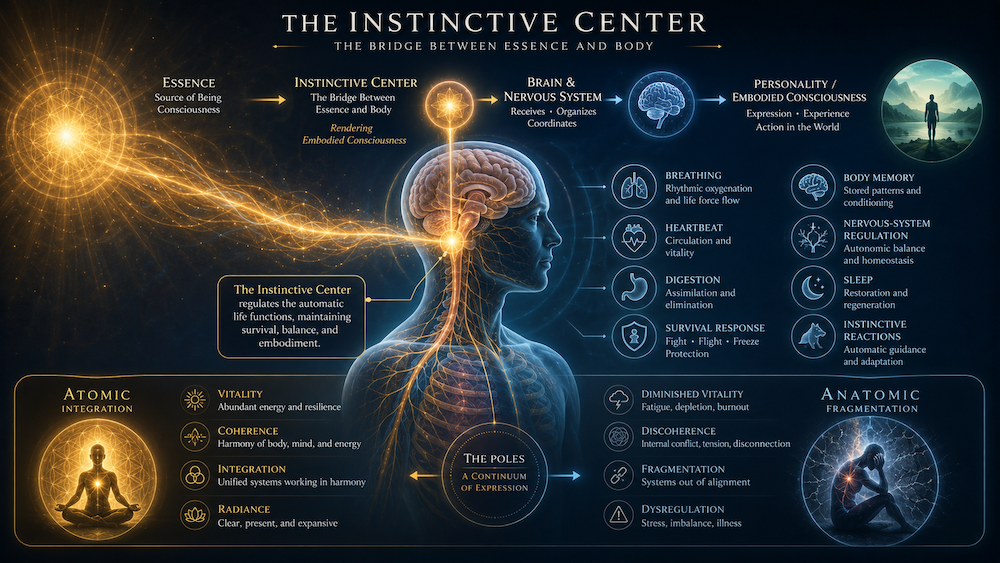
The instinctive center has not been generously written about in the Michael teachings, and its function has often remained enigmatic among Michael students. Unlike the other centers, the instinctive center operates in the background. It is not directly observable and its true nature has remained abstract.
Imagine the body as a house. The instinctive center would exist below the floorboards, intertwined with the plumbing, the electrical grid, and the very foundations that support the structure. The center regulates internal physiology that silently function below cognitive awareness, such as the heartbeat, breathing, digestion, the nervous system, and other automatic tasks that sustain life.
The instinctive center operates continuously as long as the body remains alive. Its relentless cadence, like an atomic clock embedded in the infrastructure, helps maintain synchronization in the body, including coordination with the other centers, until the last breath.
What the Earlier Material Establishes
As first stated in the original books by Chelsea Quinn Yarbro, the instinctive center is the neutral center among the others. It energetically correlates with the role of Scholar on the assimilation axis.
Its positive pole is ATOMIC; Its negative pole, ANATOMIC.
Where the intellectual center champions thought and reason, in a true-or-false dichotomy; where the emotional center vacillates between like and dislike; where the moving center responds through action, the instinctive center is not driven by the same dualities but occupies neutral ground, a foundation for the other centers. Like an ancient monolith—the body’s version of Stonehenge, carved from Essence, not ego—the instinctive center remains beneath the weather systems of False Personality. It endures the passing of time to accomplish one thing: sustain the body—the temple through which Essence lives.
What the Instinctive Center Governs
The instinctive center governs all the things you don't need to think about to stay alive.
● Heartbeat
● Respiration
● Blood circulation
● Digestion and metabolism
● The immune system
● Common reflexes
● General healing
Self-Preservation
When a hungry bear crashes through the door of your mountain cabin, the instinctive center launches the fight-or-flight response to avoid becoming dinner. With the slowly turning gears of the intellect and the paralyzing bouts of fear from the emotional center, the conscious mind cannot think fast enough in some life-or-death situations, and the instinctive center takes charge when quick action is imperative.
Cellular and Past Life Memory
Past life memories and trauma from past lives get stored into cellular memory, organized and maintained in the filing cabinets of the instinctive center. A fear of heights and other phobias stem from this center. Unresolved karma, waiting for an opportunity to be paid, maintains an active ledger there.
Can a Person Be Instinctively Centered?
Regarding personality, Yarbro claims it is extremely rare for Essence to choose the instinctive as a primary center. Sarah Chambers, one of the original Michael channels, went so far as to say that no sentient being is instinctively centered. Period.
Other channels have suggested that, although rare, there are instinctively centered people who are fully functional.
A useful maxim often applies here: When in doubt, trust in Yarbro.
Two points come to mind:
First, the instinctive center was never engineered to accommodate conscious participation. A sentient being would feel locked into the machinery, with mechanisms that don't support deliberate and reflective conscious choice. Reactions are immediate in this center. Acts of thinking, feeling, and movement are overruled in favor of breathing, digestion, circulation, and other autonomic functions. In that environment, a sentient soul would feel as if they had wandered into a funhouse mirror at a dilapidated carnival. Disorienting, disturbing, and claustrophobic.
Like the other centers, the instinctive has the intellectual, emotional, and moving parts, but the parts of center are subdivisions of the primary center. They are not fully operating parts in their own right; the nature and influence of the primary center remain in force.
Yarbo conceeds that in exceedingly rare cases, feral children and s avants have occupied the instinctive center and tapped into the parts of center, but these are not functional people in the conventional sense.
Second, if someone has channeled the Instinctive Center for an individual, they may instead have been perceiving Physical centering. And there could be a reason for this beyond simple channeling error.
Consider the intervals between the notes of a diatonic musical scale. The interval between the third and fourth notes is a half-step rather than the whole steps found elsewhere in the scale. Ignoring, of course, the half-step that exists between the seventh tone as it reunites with the first note, an octave higher.
Whether the vibrational properties of a diatonic scale are universally applicable to the numbers in Michael math is open to debate. If they are, however, the Physical Center (3) and the Instinctive Center (4) may share an unusually close energetic relationship.
● The instinctive center maintains life.
● The physical center experiences that aliveness not that far removed.
With this degree of closeness, the instinctive and physical centers share adjacent levels of the same continuum
This may help explain the confusion between the two centers.
MICHAEL: To add commentary to what has already been established, we wish to mention three further points.
First, the instinctive center is not the same as the primary working centers (intellectual, emotional, moving). A personality rarely fixates in the instinctive center, and that is only if the personality cannot function normally with the other working centers, because of a congenital brain defect or other obstacle.
Second, the primary working centers are inherently wired to react and assist in the formation of individual choices. The instinctive center, by contrast, acts as the body’s security detail, responding immediately and decisively to anything that threatens survival.
Third, the instinctive center primarily functions much like a thermostat that operates continuously to maintain a state of equilibrium, making energetic adjustments where needed and metaphorically putting out fires in any regions of the body that require urgent attention.
Altogether, despite disparate parts in the body that work separately, the instinctive center works at all times to achieve a greater whole.
The Instinctive Center as the Infrastructure of Embodiment

A Recent Clarification
While the instinctive center has long been recognized as a center about instinct, survival, and habit, what had not been known is that a broader function exists where the instinctive center also serves as a mechanism that allows the consciousness of a soul to sustain itself in the body.
MICHAEL: It is true that essence provides the juice, or the electrical current, so to speak, that awakens consciousness in the brain. The brain functions from the instinctive center and governs all biological and electrical processes that keep the body alive.
The instinctive center plays a considerable role in coordinating the exchange between body and soul, and regulating the connection. The positive pole functions as a rendering instrument, ensuring that the coupling remains integrated in its vibrational merger. The negative pole is a less vibrant state when the body is overwhelmed with illness or other varieties of dysfunction or psychological malaise.
Further channeling expanded the mechanism:
MICHAEL: “The instinctive center acts as a conduit for the incoming soul and provides the infrastructure for both matter and spirit to align as an organism that could only exist on the physical plane in tandem.
That the positive pole of the instinctive center is labeled Atomic is no coincidence, and the term was given by design.
The subatomic particles of the body are the access point of the soul, and the instinctive center coordinates how the soul synchronizes with the neurological pathways of the brain.
It may be helpful to view the instinctive center, figuratively at least, as a hangar where commercial aircraft, following a long flight, return for system checks, repairs, and, if needed, complete overhauls. The instinctive center is like a maintenance shop that runs twenty-four hours a day in the body, not only to sustain the life of the body but also to maintain the continued embodiment of Essence.
Think of Essence as the chief architect and the instinctive center as the operations manager.
What was not revealed in the earlier channeling is the importance of the instinctive center in maintaining the integrity of matter and soul throughout a lifetime. The internal monads, for instance, act as markers within the life cycle, and while Essence is at the helm during this voyage, the instinctive center, relying on its internal navigation, releases buoys along the journey, synchronized with progress made on the life plan, that signal the next monadal transition.
The instinctive center is also a repository of data concerning the operational efficiency of the body—where its strengths lie and where its weaknesses may lead to roadside repairs. Essence uses that data to map the optimal trajectory of the life as it unfolds. Detours are frequent, and occasionally an unexpected dead end terminates the journey.
Taken together, these passages suggest that the instinctive center juggles more plates than originally thought. Ensuring the survival of the body, while of tremendous importance, is only one facet of this center. Coordinating the infrastructure that allows soul and matter to become embodied, like the alliance between violin and virtuoso, makes possible a life that is not only played into being but emerges as a unique art form: a human personality.
How Embodiment Occurs
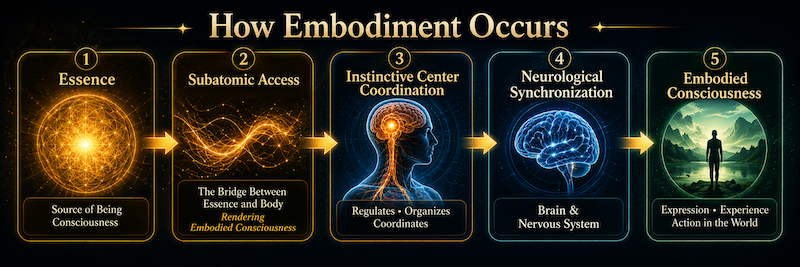
According to the new channeling, embodiment is not as simple as switching on a light in the brain. An act of coordination must occur to allow spirit and matter to align as a single living organism.
The subatomic structure of the body is the initial point of access. Essence engages with the body, but not so thoroughly that spirit becomes matter. The instinctive center acts as a coordinating mechanism, configuring the connection into a translatable form the nervous system can receive. (This is explained more comprehensively in an upcoming article, "How the Soul Inhabits the Body")
From there, the incoming soul synchronizes with the neurological pathways of the brain. Essence acts as the animating catalyst that spawns the first state of consciousness in the body, and the instinctive center regulates and integrates the connection, tuning it to the body until both spirit and matter resonate as one.
Embodiment occurs at first breath.
The sequence follows this five-step trajectory:
➊ Essence ➋ Subatomic Access ➌ Instinctive Center Coordination ➍ Neurological Synchronization ➎ Embodied Consciousness
Imagine a steam locomotive chugging away from the station.
Essence represents the flames of potential in the firebox that power the engine. Subatomic access is where water converts to steam. The instinctive center is the boiler that regulates the force. Neurological synchronization occurs through the coordinated efforts of the pistons, valves, and drive rods. And embodied consciousness is the final result: steel wheels gripping the track, and the incarnational journey begins.
Atomic and Anatomic
At first glance, the positive and negative poles of the instinctive center look like a crib sheet for a quantum physics course. But rest easy. Schrödinger's cat won't make an appearance anywhere in this piece. The poles reveal the spectrum that exists between the atomic and anatomic, from integration and coordination to fragmentation and loss of homeostasis.
Atomic (Positive Pole)
The term Atomic, sometimes altered by other channels because it seemed vague, turned out to be surprisingly apt.
It's operating system is twofold: One, to maintain a homeostatic state in the body, cohesive and elemental, where the energy driving the physical systems is unfettered and unified. Two, to coordinate an integration between body and soul until the organism is no longer viable.
An attainment of perfect health, however, is not a prerequisite for occupying the positive pole. A person can be ill and still remain integrated. In other words, the Atomic doesn't prevent illness, but when available immune responses work together as a whole, they avoid the pitfall of systems being at cross-purposes.
Anatomic (Negative Pole)
In the Atomic pole, the systems of the body flow effortlessly, as if a superfluid coursed through the veins with zero viscosity and without wasted energy. In the Anatomic pole, the instinctive center is like an engine running out of oil. What once glided now grinds. The system becomes mechanical, with each part straining under the stress, the friction and heat causing the parts to fuse together until the engine begins to seize.
What once flowed as a whole is now fragmented. The organs in the body struggling under the strain of being less unified. This can be a temporary setback, caused by prolonged illness, exhaustion, trauma, psychological duress, or something neurological, but the body is resilient and often resets.
In more extreme cases, the systems of the body collapse and fail.
Channeling Q & A

How are the centers different (if they are) from the other overleaves?
MICHAEL: The centers differ in several ways. They are not chosen pre-incarnationally in terms of a life plan, but they are partly intuited before the life begins. Meaning, the chosen center is usually not a surprise. However, the incoming fragment ultimately adopts the center most suited for the developing personality as the circumstances of life unfold. This allows for any adjustments needed that may not have been anticipated pre-incarnationally. It also allows the evolving fragment to gauge the impact of how a potential primary center might interact with the other overleaves and its suitability for the life task. Because the centers can all be experienced to certain degrees before making the final purchase, so to speak, this flexibility provides a test drive of these energies after the life has begun.
The other overleaves, with the exception of the chief features, are activated and fixed at birth.
A common misunderstanding with the centers is that they do work that's similar in nature to the other overleaves. But the goal, attitude, and mode are instigators in life, the cause of things that happen, while the centers are the effect, the reactions to what life brings. To illustrate, in a figurative sense, the cards are shuffled by the dealer and the centers react to the hand that was dealt.
The centers also operate as regulatory stations in the way energy is distributed throughout the body. Chakras are partly responsible for this job, but the centers are more fine-tuned to the demands of the personality, where split second adjustments are made to route needed energy to the most appropriate center for the task. The centers, in this respect, are personalized and configured to react moment-to-moment, whereas the chakras are like mini power plants that feed energy to the centers, acting as transformers along the grid. The chakras do correspond with the centers on some levels, but the centers have more specific tasks. The chakras are location specific, but the centers are somewhat amorphous in the body. The emotional center, for instance, tends to follow nerve networks that are wired throughout the body, which explains why intense emotions pulsate at full length, not one location.
The most obvious difference between the centers and other overleaves is that all the centers can be experienced in life, especially if they are balanced. The primary center still remains, but where the overleaves in their common pairings are typically served like a soup du jour and entrée — where reevaluation pairs with growth, discrimination pairs with acceptance, and so on — the centers are like a smorgasbord.
Why are there only two higher centers and not three?
MICHAEL: The concept of higher centers has been a chronic source of confusion in our teaching, partly due to a lack of symmetry where some channels felt the lower centers should have higher counterparts that match: for example, emotion/higher emotion, intellectual/higher intellectual, moving/higher moving. Even if incorrect, this conclusion was logical and had merit. However, intellectual bias from some of our channels distorted the actual truth and cemented false conclusions into books and other sources of information.
In short, only two higher centers exist, and for a simple reason: the higher emotional center is energetically aligned with ASTRAL energy, and the higher intellectual center is energetically aligned with CAUSAL energy. The moving center, which is sometimes referred to as a higher center, is not connected to the energy of a higher plane. It is earthbound. A more correct attribution of its qualities would be as the cardinal action center. Therefore, it is easily accessible, whereas the higher emotional and higher intellectual are not.
Understand that the higher centers are portals to essence, and essence connects to you through the higher centers. Contact with the higher centers is therefore contact with essence. This is not just a form of communication, like sending text messages to and fro, but where you momentarily merge with essence at the very level of essence. The higher centers are then a conduit to a greater state of awareness, the means to be at one with your highest potential, or authentic self.
The sheer intensity of this connection, however, that bridges your three-dimensional world with something higher, may only sustain itself in short bursts lasting no longer than mere seconds to several minutes. It would be similar to plugging an American appliance into a European outlet with a voltage two times stronger. This would fry the circuits. With your soul, no physical damage results, but after a short period, the sheer magnitude of the exchange, perpetually ecstatic and profound, severs the connection.
The glimpse you get of essence — a life with the capacity to live beyond the restrictions of false personality — is a model of what you could strive for in life and who you could be. Essence is not only a potential, it is a germinous seed that sprouts within as you awaken to higher states of consciousness.
Difference Between the Action Centers
MICHAEL: We are aware of the confusion regarding the action centers. We have not intervened to any great extent because the deliberation that ensued around this topic led students to look at the centers more objectively. The other overleaves have often overshadowed the centers, so we welcomed the review. Some clarity, however, is needed.
First, you must understand the distinctions between ordinal and cardinal energies. We could say the ordinal axis conserves energy; the tortoise withdraws into its shell. Whereas the cardinal axis expends energy; the fleet-footed hare boundlessly exerts its presence expansively. Both energies, though, emanate from the same well. Meaning, the distinctions are not as diverse as they seem.
Like the expressive qualities of the artisan and the sage, which operate as two sides of the same coin, the action centers are united on the same front. Namely, action. Thus, to understand the difference between the physical center and the moving center, look at how they run their energy.
Our ordinal tortoise spends part of its day either in a contracted state, deliberating its chosen actions in the comfort of its shell. Meanwhile, our cardinal hare is a blur of activity, racing to and fro, striving to make his presence known in the world. Both expressions of energy eventually reach the same destination.
The physical center generates energy that remains in the body. It's activated, it's energized, and more importantly, it's alive. This animating quality cannot be underestimated when describing the life force of the physical center.
What is the difference between the positive and negative poles of the higher centers?
MICHAEL: This may surprise you, but the difference is greater than you might expect.
First off, essence and the higher centers are beyond the influence of the law of opposites and any semblance of polarity. The standard definition of positive and negative poles does not apply. The poles, as connected to essence, could be called tier one and tier two. Tier one represents the portion of essence outside the physical plane that is connected to the Tao, and tier two, the portion inside that is more intimately connected to the soul. Call it a coordination of one foot in, one foot out.
The positive pole of a higher center is what we often refer to as essence contact, but at the level of essence. The contact, because you are momentarily reaching beyond the confines of physicality and penetrating a higher realm while still in a human body, is, for want of a better word, intense. Visceral, exhilarating and expansive are other words. This is the closest you will ever get to a higher plane while still lodged in the familiar comforts of the physical. The experience is rarely forgotten, and for some people it is so life changing that it becomes spiritually addictive.
As mentioned already, the higher centers, especially when accessing the positive poles, serve as reminders of your greater potential as a soul and a human being. Anything you see, feel or realize during the experience is possible to you and within your grasp. You are not glimpsing ice castles of imagination, but merging with a representative of yourself that simultaneously exists within you already. All things are possible in this realm. You are gazing into a mirror that reflects a higher you. The reason the experience resonates in a visceral way is because it is occurring in real-time. The realm you have cracked occurs beyond time, of course, but your presence as a living, physical being provides the grounding found in the present.
In the negative poles (tier two) of a higher center, the experience is more subtle. The connection is not direct, and the exchange of energy is on a subconscious level. Without a direct connection, the higher center operates like a sequence of energetic tidal currents, with gentle waves transmitted over time, offering gifts of insight and the means of knowing something greater without knowing it in a conventional sense. This is not a way of accumulating knowledge like what you find in libraries or academic institutions. The higher centers are not about thinking, feeling or doing. The higher centers are portals to essence and the energies of truth, love, and beauty.
What makes the cardinal action center different or special?
MICHAEL: Understanding how and to where the centers align is the key to that question. The ordinal centers work best when they align with each other. They traditionally act as independent spheres of energy that handle specific tasks and, within those parameters, do those tasks well. But when they work in coordination with each other, together in unison, they create a harmonious fusion, which leads the centers to function together as a whole. This is the most desirable outcome.
We have previously said the higher emotional and the higher intellectual centers are energetically aligned with the astral and the causal. The reason we sometimes refer to the cardinal action center as the higher moving center is because it also plays a part in alignment, but in this case, the alignment of the lower centers.
Think of the cardinal energy of the moving center as a turn of the century traffic cop that stood in the middle of an intersection and directed the flow of traffic to avoid collisions and pile-ups. Since the jurisdiction of the cardinal action center is the physical body, which includes the lower centers, this king-aligned center acts with governing powers, in a way, the boss, so to speak, and leads the lower centers, or at least energetically helps them, to work as a cohesive unit.
Regarding how the cardinal action center accomplishes this is the answer to what makes it special. As chairman of the board, if you will, the cardinal action center, by virtue of its natural proclivities for movement, adds the wheels to the cart, so to speak, and pulls the cart, as well. This is not necessarily a conscious endeavor, but a byproduct of the influence its energy has on the other centers. It helps to pull them together, grease the wheels, and avoid ruts in the road that leads to getting stuck. The takeaway here: the other centers have a static quality if not exposed to any moving center influence.
A moving center trap, for this reason, can be a daunting obstacle to dislodge. The wheels of the cart have come off. Refer to exercises we once suggested as a remedy to this hurdle.
Peak performances, those physically focused highs that top athletes ecstatically describe, where they feel totally in sync with their body and part of something greater than themselves, is another special quality, a higher moving experience not uncommon with the cardinal action center.
Understanding the New Material About the Centers: COMMENTARY
The centers in the Michael teachings have been a source of contradiction and controversy for several decades. Part of the problem stemmed from thinking the centers were the same as the overleaves. They are not. The overleaves help form the structure of personality; the centers integrate and react to life experiences.
Early channels also used a seven-fold pattern that highlighted pairs: artisan/sage, reevaluation/growth, reserve/passion, etc. They naturally applied this logical symmetry to the centers. It was aesthetically appealing—especially in diagrams and charts: Intellectual/Higher Intellectual; Emotional/Higher Emotional; Moving/Higher Moving. The "rule of three" looked tidy.
Needing something for the fourth position in this seven-fold pattern, the instinctive center fit nicely. Although it serves more as a metaphor than a destination. The instinctive center doesn't alternate with the other centers. It runs in the background at all times, like the operating system on a computer. You can't really slide to the instinctive center by choice. That realization shifts the focus from appearance to function
Understanding the functionality of the centers is more important than their positioning in a diagram. Instead of viewing the centers in a stack of seven, a circular outline seems more helpful. (See image)

Where the early channels went wrong was in imagining a visual symmetry. This compelled them to force-fit the higher centers together in a way that didn't reflect their functionality. Both the higher emotional and intellectual align to a higher plane, the astral and the causal. The moving center, however, is earthbound. While it can evoke what is sometimes called a peak performance, it does this within the physical dimension. The moving center is fully accessible to all, and Yarbro confirmed this in her own channeling. The actual alignment is simpler and more elegant.
The Higher Centers:
● Higher Emotional → Astral plane (Love)● Higher Intellectual → Causal plane (Truth)
As stated in the channeling, the moving center poses a special distinction, acting as a "traffic cop," so to speak. It helps to coordinate and integrate the other centers. It doesn't, though, transcend to another plane. There is no higher plane that corresponds with the physical.
This updated understanding provided by the channeling then confirms that there are only two higher centers, and the idea of a higher moving center was a misinterpretation.
Again, understanding the centers through their functionality is the best approach when working with them, both through application and in tolerating the center-driven reactions of others.
Essence Contact and the Higher Centers
The channeling also showed how students and channels often misunderstood the higher centers to be pipelines of normally unattainable insights and higher learning—as if one could download something akin to Einstein’s theory of relativity. Essence contact, however, is more like self-remembering, a conscious awareness of both self and being, where you momentarily become one with essence, and glimpse the shifting contours of reality as it is. In a flash, you achieve essence consciousness—or at least it feels that way—and realize the potential of your authentic self.
Using the labels mentioned in the channeling, where the positive and negative poles were switched out in favor of a non-dual system, Tier One is where essence initiates a state of self-remembering—the experience of union with essence. Tier Two is where the fruits of essence contact potentially take form, filtering into life as inspiration or new clarity.
The higher emotional center invigorates your soul with feelings of ecstasy, and compassion for all. You now see others with an objective gaze that dissolves past wrongs and grievances. Unconditional love becomes your worldview.
The higher intellectual center anchors you in a state of profound peace—a place where stillness quiets the cognitive turbulence of incoming thoughts, fragments of dialogue, and relentless problem-solving. All that remains is the sense of knowing: an objective awareness that perceives truth, that knows truth and nothing else. Truth simply is.
Cognitive brilliance, often found in the work of geniuses, arises when an ordinary center is mined to a depth most people rarely reach. The creative outputs and innovations may seem extraordinary, but in most cases, they are a product of the mind. The higher centers are experiences, not data dumps.
Some students, perhaps impressed by their own cognitive brilliance, have subscribed to theories that the higher centers were responsible for their breakthroughs. This is more theory than reality. Historical observation can easily test this.
Many of the world's significant innovations came from people who were brilliant but neither emotionally balanced nor kind.

Despite the enormous contributions made by these individuals, their work often emanated from false personality. Brilliance alone is not evidence of higher-center activity. The higher centers wouldn't have bestowed these people with more talent. Their gifts were plentiful already. If, however, their higher centers had been more integrated, the brilliance of their minds would have been balanced by the wisdom of their hearts. Instead of being tortured artists and anxiety-ridden inventors, their lives might have been less chaotic and more harmonious as a whole.
Final Note
Of course, longtime students and channels may question this revision. However, the centers have been controversial because of the contradictions found in books. There have been opposing camps of interpretation. Still, truth in the Michael Teachings is almost always subject to refinement. In my opinion, I believe this channeling bridges some gaps and gets closer to the mark.
More Articles
● Michael Channeling on the CENTERS
● Higher Intellectual
● Higher Emotional
Ready to Go Deeper?
Awareness is the first step. Next, learn how to apply Roles, Overleaves, and Poles in daily life.
Explore Applying Michael →
Further Reading in Our ....

Curious About Your Own Soul Age? Get it Professionally Channeled
Learn your soul age, unique soul type, and personality traits. All at half the cost of other channels.
RELATED ARTICLES


The Old Soul
By PHIL WITTMEYERLearn about the Overleaves, personality traits that shape our individual experence during each lifetime.
READ MORE